

You cleared IELTS, your CRS score looks strong, and the invitation to apply is finally in your inbox. Then one line in the checklist makes you pause: complete your immigration medical exam. For most applicants, this is a routine step. For a smaller group, a health condition can slow the file down or put it at risk. So what medical conditions affect a Canada PR application, and how worried should you be? Here is a clear, step-by-step breakdown for 2026.
Quick answer: IRCC can refuse PR on health grounds for three reasons: danger to public health, danger to public safety, or excessive demand on health and social services. In 2026, the excessive demand limit is CAD 28,878 per year (CAD 144,390 over five years). A diagnosis alone does not decide the outcome. The expected risk and cost do.
What Medical Conditions Affect a Canada PR Application?
Think of the health check as three gates rather than a list of banned diseases. Your immigration medical exam results decide whether any gate needs a closer look.
| Reason | What IRCC checks | Example |
| Danger to public health | Risk of spreading an infectious disease | Active tuberculosis, active syphilis |
| Danger to public safety | Risk of sudden incapacity or unpredictable, violent behaviour | A condition that can cause sudden loss of physical or mental abilities |
| Excessive demand | Expected cost of care against the yearly limit, or impact on wait times | Dialysis, cancer treatment, long-term psychiatric care |
For most Express Entry applicants, excessive demand is the issue that comes up most often, because it is about cost and wait times rather than infection or safety. Refugees and protected persons are exempt from this rule.
Since IRCC revises these limits every year, we share quick updates on our LinkedIn and Facebook pages, so you can follow along there.
Top 10 Medical Issues That Can Trigger a Closer Look
No condition is an automatic “no”. These are situations where an officer may ask for more evidence, based on the criteria IRCC publishes.
- Active tuberculosis: Spotted through the chest X-ray. You may need to complete treatment before the file moves ahead.
- Active syphilis: Found through the blood test. Your physician guides treatment, and you should keep proof of it.
- HIV: Screened through the blood test. A positive result is not an automatic refusal, and officers weigh the expected cost of care.
- Kidney failure needing dialysis: Dialysis is named in IRCC’s cost assessment, and it is a high-cost service.
- Cancer needing chemotherapy or radiotherapy: Both appear in IRCC’s list of health services counted toward the limit.
- Psychiatric conditions needing ongoing care: Psychiatric services count toward the cost estimate.
- Risk of sudden incapacity: A public safety concern, judged on how likely it is to happen.
- Risk of unpredictable or violent behaviour: Also a public safety concern, assessed on the medical evidence.
- Costly long-term medication: Pharmaceutical costs are added to the total.
- Ongoing hospital-based care: Hospital services are part of the calculation too.
What Is the Excessive Demand Limit in 2026?
Here is where the numbers matter. IRCC sets the limit at three times the average per-person public spending on health and social services in Canada, and it updates the figure every year. For 2026, it is CAD 28,878 per year, or CAD 144,390 over five years. The second route is wait times: if the services you would need could worsen waiting times for Canadians, that can count
The limit has moved a lot. Before March 2022, it was only CAD 8,019 a year, and it has grown roughly 20% since 2022 alone. Here is a simple example: someone whose condition is well managed with low-cost medication is likely to stay far below CAD 28,878 a year, while a person who needs regular dialysis could cross it. The officer estimates the cost, so strong medical evidence matters.
What Is an Upfront Medical Exam for Canada PR?
An exam is “upfront” when you complete it before IRCC asks for it. Since 21 August 2025, Express Entry applicants must complete it before applying. For other PR applications, IRCC sends instructions after you submit a complete application.
Only an IRCC-approved panel physician can perform the exam, and you pay the fees yourself. Pick a doctor from IRCC’s list for your country, and carry your passport, a list of current medicines and any old medical reports. The routine exam includes a medical history review, a physical exam, a mental examination and the age-based tests shown below.
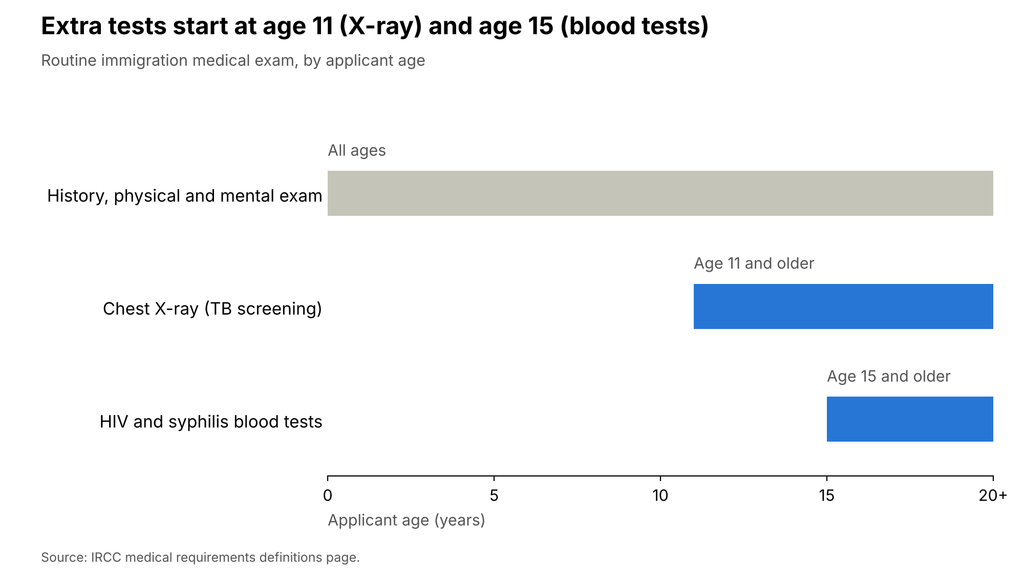
Results are generally valid for 12 months, so avoid booking too early.
What Is the Next Step After the Medical Test for Canada Immigration?
The panel physician sends your results straight to IRCC, and you receive an information sheet as proof that you completed the exam. The doctor does not make the final decision. IRCC does. Results usually show up in your IRCC account within about 30 days of booking, though extra tests can add time. If a concern appears, you will first get a procedural fairness letter explaining the reason, and you can reply with evidence or a mitigation plan before any final decision. Do not repeat the exam unless IRCC tells you to.
How Can You Protect Your PR Application?
A little preparation goes a long way. Here are the steps Esse India recommends to every applicant:
- Disclose every past and existing condition to the panel physician. Hiding details can delay processing and creates bigger risks later.
- Collect old reports, prescriptions and a doctor’s letter explaining your diagnosis and treatment.
- Book the exam on time, keeping the 12-month validity in mind.
- If you get a procedural fairness letter, answer with updated medical evidence, treatment plans and realistic cost details.
- Explore lower-cost treatment options or private coverage, which can strengthen a mitigation plan.
- Avoid rushing into a fresh exam unless IRCC asks for one.
Need Expert Help With Your Medical Review?
Medical questions can feel personal and stressful, and the rules change every year. Esse India focuses on genuine immigration guidance, from document checks to timelines and procedural fairness replies. You can contact Esse India for a profile review, or read an Esse India success story to see how real cases moved forward. No consultant can promise an approval, because IRCC makes the final call. A clear, honest plan simply makes your file stronger.
Conclusion
A health condition does not automatically close the door to Canada PR. IRCC looks at risk to public health and safety, and at whether your expected care costs stay under the 2026 limit of CAD 28,878 a year. The best approach is simple: book your exam on time, share your full medical history, and keep your reports ready. With honest preparation, most applicants move through this step without trouble.
Frequently Asked Questions
Yes, many applicants do. IRCC checks risk to others and expected cost against the yearly limit, not the name of the diagnosis alone.
The exam is not a pass or fail test. IRCC reviews the results and decides whether you are admissible on health grounds.
Generally 12 months from the exam date.
Refugees and protected persons.
Yes. You can contact Esse India to review the letter, organise medical evidence and plan a clear response before the deadline.
IRCC checks whether you could spread infection, risk public safety or strain health services. The doctor reviews your history, does a physical and mental exam, and orders age-based tests.
Yes, but it is uncommon. IRCC decides, not the doctor. If a concern appears, you first get a procedural fairness letter and can respond with evidence.
You must qualify under a program like Express Entry or a Provincial Nominee Program, based on age, language, education and work experience, and clear medical and security checks.
A history review, physical exam and mental exam. A chest X-ray is needed from age 11, and HIV and syphilis blood tests from age 15.