
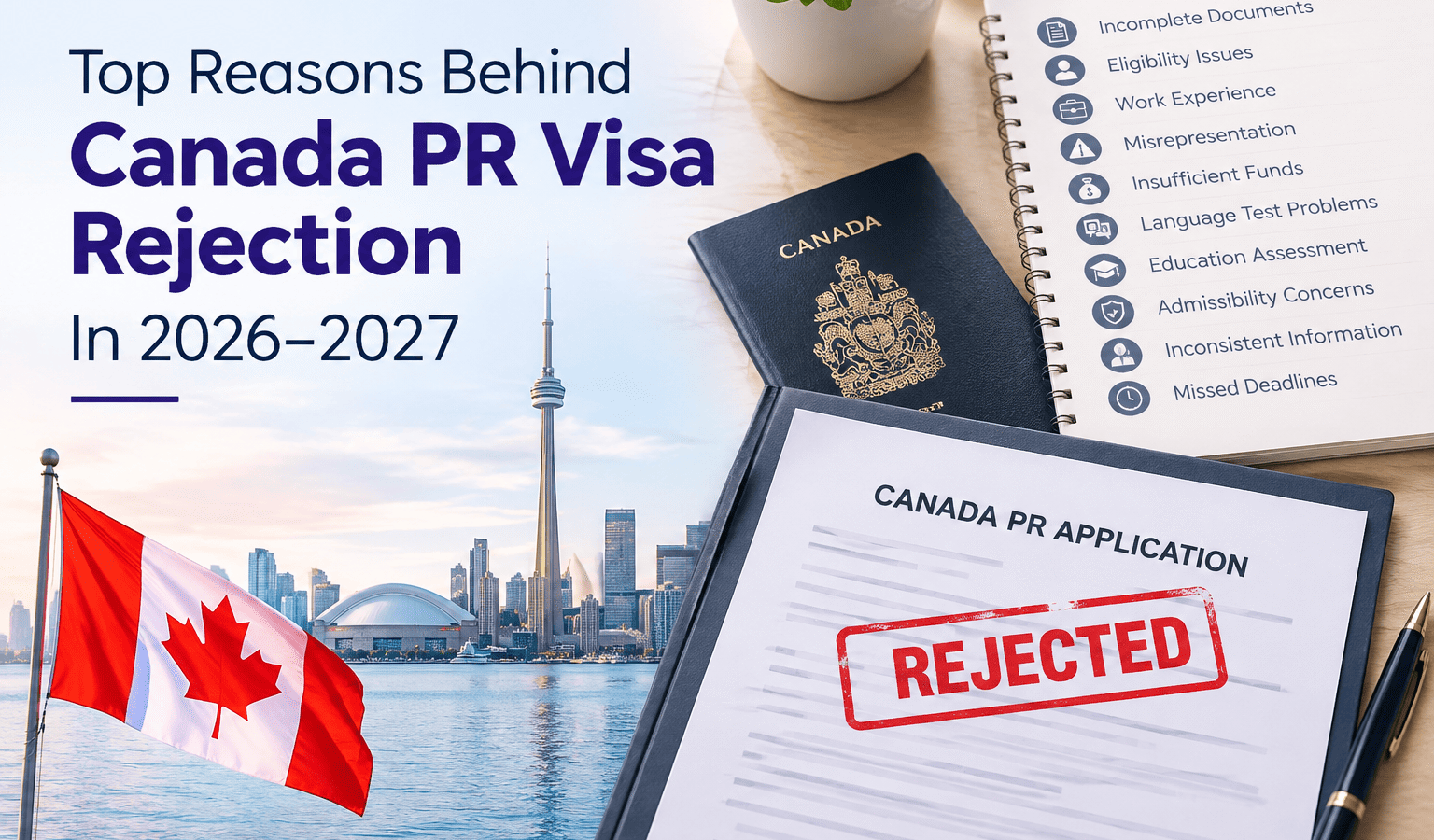
Applying for Canadian permanent residency is a major step for many Indians planning to settle abroad. However, incomplete documents, eligibility issues, or inaccurate information can lead to Canada PR visa Rejection. Esse India shares helpful immigration guidance to raise awareness and help applicants understand common mistakes before applying.
Every refusal has different reasons depending on the immigration program and the applicant’s circumstances. Understanding the refusal reasons can help applicants identify problems and explore suitable next steps. A rejection does not always mean they can never apply again.
What Does Canada PR Visa Rejection Mean?
Canada PR visa rejection generally refers to a situation in which Immigration, Refugees and Citizenship Canada (IRCC) refuses an application for permanent residence. Applicants may also encounter a returned application if it is incomplete or does not meet the applicable submission requirements.
According to IRCC, permanent residence decisions can depend on program eligibility and admissibility assessments, including medical examinations, police certificates, and background checks. Applicants should therefore review both their eligibility and the evidence required for their particular immigration pathway.
Top Reasons Behind Canada PR Visa Rejection in 2026–2027
1. Incomplete or Incorrect Documents
Missing, incorrect, outdated, or inconsistent documents are among the practical problems applicants should check before submitting a PR application. The exact document checklist depends on the immigration program and personal circumstances.
For example, an applicant may forget a required civil-status document, submit an unclear employment reference, or upload a document that does not meet the stated requirements. Documents in languages other than English or French may also require an appropriate translation. IRCC warns that missing required documents can lead to an application being refused or rejected. Reviewing the official checklist is therefore an important step before submission.
2. Not Meeting the Immigration Program’s Eligibility Criteria
Canada offers several permanent residence pathways, and each has its own eligibility requirements. Applicants who qualify for one pathway may not automatically qualify for another.
Before applying, check your work experience, education, language results, and other relevant criteria against the rules of the selected program. Do not assume that meeting a general immigration requirement guarantees eligibility for every PR pathway.
Esse India encourages applicants to research their intended immigration route carefully and seek clarification when a requirement is unclear. Understanding the difference between general eligibility and program-specific criteria can help applicants make better-informed decisions.
3. Inaccurate Information About Work Experience
Work experience can play an important role in many Canadian immigration pathways. However, the information in an application should be accurate, consistent, and supported by suitable evidence.
Problems may arise when an applicant provides unclear job duties, incorrect employment dates, unsupported claims about work hours, or experience letters that do not adequately establish the claimed role. A job title alone may not be sufficient to demonstrate that the experience meets a program’s requirements. Never exaggerate professional experience to improve an immigration profile. If an application is assessed against evidence that does not support the claims made, the applicant may face serious consequences.
4. Misrepresentation or False Documents
Providing false information or misleading documents is a serious immigration issue. This may include fabricated employment records, altered educational certificates, false financial evidence, or deliberately concealing relevant information.
Misrepresentation is not simply a minor paperwork mistake in every case. Depending on the circumstances and applicable law, it can lead to refusal and a finding that affects future immigration applications. Canadian immigration rules can impose a five-year inadmissibility period for misrepresentation, subject to the applicable legal provisions and exceptions.
Esse India recommends a transparent approach to immigration preparation: use genuine documents, verify every claim, and correct errors through the appropriate process. Accuracy protects the integrity of an application and helps applicants understand the risks before making important decisions.
5. Insufficient Proof of Settlement Funds
Some Canadian PR programs require applicants to show sufficient settlement funds. Incomplete bank documents or funds that do not meet IRCC requirements may cause problems. Eligible Federal Skilled Worker and Federal Skilled Trades applicants must provide proof of funds unless an exemption applies. Always check the latest official requirements before applying.
Before submitting proof of funds:
- Check the current financial threshold for your family size and program.
- Obtain the required official bank letters and supporting evidence.
- Confirm that the funds are accessible and meet the program’s rules.
- Explain the source of funds when required and ensure that all information is accurate.
6. Low Language Test Scores or Invalid Results
Language ability plays an important role in eligibility and ranking for several Canadian immigration programs. Applicants must meet the required English or French language scores and ensure their test results are valid for their chosen immigration pathway.
Expired test results, low scores, or incorrect information in the application may create problems. Applicants should check the latest IRCC requirements and verify that their scores match the official test report. Improving language proficiency may strengthen an Express Entry profile, but it does not guarantee an invitation or PR approval.
7. Education Assessment or Qualification Issues
Applicants with education completed outside Canada may need an Educational Credential Assessment (ECA) to claim education points, depending on their immigration pathway. Problems can arise if the assessment is missing, outdated, or does not cover the qualification being claimed.
Before applying, check whether your program requires an ECA and ensure your report meets the relevant requirements. Enter your education details accurately, as an ECA helps verify your qualifications but does not guarantee Canadian PR eligibility or approval.
8. Medical or Criminal Admissibility Concerns
Meeting Canada’s PR eligibility requirements does not guarantee admissibility. Applicants may need medical examinations, police certificates, and background checks as part of the immigration process. Missing documents or concerns related to criminal history or medical conditions may affect the application.
IRCC assesses medical and criminal admissibility under Canadian immigration rules. Applicants should follow official instructions, submit required certificates, and seek qualified advice if they have concerns about a past conviction or medical issue.
9. Inconsistent Personal or Family Information
Applicants must provide accurate and consistent information about their marital status, dependent children, previous marriages, and family relationships. Incorrect dates, mismatched details, or undeclared family members may raise concerns during the application process.
Before submitting your Canada PR application, verify all personal details against official records. If you discover an error after submission or your circumstances change, follow the appropriate IRCC process to report it. Being honest and keeping information up to date can help prevent avoidable complications.
10. Missing Deadlines or Ignoring IRCC Requests
Canada PR applicants must meet deadlines for submitting documents, completing medical exams, and responding to IRCC requests. Missing a deadline may delay processing or affect the application outcome.
Check your IRCC account regularly, follow instructions carefully, and keep track of important dates. If a document is delayed, review official guidance and act promptly, as an extension or explanation may not always be accepted.
How to Reduce the Risk of Canada PR Visa Rejection
Although no applicant can guarantee a positive decision, careful preparation can help reduce avoidable mistakes. A responsible approach involves checking the current rules, collecting reliable evidence, and ensuring that every claim in the application is accurate.
- Use this checklist before submitting your application:
- Confirm eligibility for the selected immigration program.
- Check the validity of language test results and educational assessments.
- Match employment details with genuine supporting documents.
- Verify settlement fund requirements and supporting bank records.
- Arrange required police certificates and medical examinations.
- Review every form for missing information or inconsistencies.
- Check translations, signatures, fees, and submission deadlines.
- Save copies of documents and monitor official IRCC communications.
This checklist is a general preparation tool, not a substitute for the official document checklist for your application. Requirements can differ between Express Entry, provincial nomination, family sponsorship, and other permanent residence pathways.
How to Identify Immigration Fraud Before Applying
Concerns about Canada PR visa rejection sometimes lead applicants to seek help from consultants or agents. Professional assistance may be useful for understanding complicated requirements, but applicants should verify the credentials and practices of anyone they hire.
Watch for these warning signs:
- Guaranteed visa approval: No consultant can guarantee a Canadian immigration decision.
- Fake job offers: Be cautious of anyone selling employment offers or promising PR through a job without a legitimate process.
- Unclear fees: Request a written breakdown of professional fees, government fees, and refund conditions.
- False documentation: Never agree to submit fabricated employment letters, bank statements, or educational records.
- Pressure to pay immediately: Take time to verify the service provider before making a payment.
- Unverifiable credentials: Check whether the person providing regulated Canadian immigration advice is authorised to do so.
Applicants can consult official Canadian government resources to understand who is authorised to provide paid immigration advice and how to identify fraudulent practices.
What Should You Do After a Canada PR Visa Rejection?
Receiving a refusal can be disappointing, especially after investing time, effort, and money in an application. However, the most useful next step is to understand the decision rather than immediately submitting another application.
Step 1: Read the Refusal Letter Carefully
Identify the reasons given by the immigration officer. Determine whether the decision relates to eligibility, missing evidence, discrepancies, admissibility, or another issue.
Step 2: Review Your Original Application
Compare the refusal reasons with the forms and supporting documents you submitted. Identify which facts or evidence need further review.
Step 3: Check Your Available Options
Depending on the decision and circumstances, you may be able to submit a new application, correct an issue, seek legal advice, or explore a review or appeal process where available. These options are not available in every situation and may have strict deadlines.
Step 4: Avoid Repeating the Same Mistakes
Do not simply resubmit the same documents without addressing the refusal reasons. Make sure any new application meets the current requirements and accurately reflects your circumstances.
Step 5: Seek Qualified Advice When Necessary
If the refusal involves alleged misrepresentation, complex admissibility issues, or a potential legal challenge, consider consulting an appropriately authorised Canadian immigration professional or lawyer.
A previous refusal does not automatically mean that every future application will fail. However, the correct next step depends on the specific refusal grounds, applicable rules, and the evidence available.
How Esse India Can Help Applicants Make Informed Decisions
Understanding Canadian immigration requirements can be challenging, especially when online information is confusing or outdated. Esse India aims to help applicants understand Canada PR eligibility, documentation requirements, settlement funds, and common application mistakes. Its guidance can help individuals identify areas that need attention and make informed decisions before applying. However, no consultant can guarantee PR approval, as the final decision rests with Canadian immigration authorities. Before choosing any immigration service provider, applicants should verify credentials, review written fees and service terms, and ensure all documents are genuine.
Esse India vs General Immigration Service Expectations
| Factor | What to Look for with Esse India | What Applicants Should Expect from Any Consultant |
| Eligibility guidance | Clear information about Canada PR pathways | An explanation of relevant eligibility requirements |
| Document review | Guidance on identifying missing or inconsistent documents | Careful review of supporting evidence |
| Settlement funds | Information about applicable financial requirements | Guidance based on current official rules |
| Transparency | Clear communication about services and fees | Written terms and understandable charges |
| Visa approval | No guaranteed outcome should be promised | The final decision rests with IRCC |
| Fraud prevention | Encourage genuine documents and informed decisions | Verifiable credentials and ethical practices |
Conclusion
The main reasons for Canada PR visa rejection in 2026–2027 include incomplete documents, eligibility issues, unsupported work experience, false information, insufficient funds, language test problems, and missed deadlines. Applicants should check the latest IRCC requirements and ensure their information is accurate before applying.
Esse India encourages applicants to understand the immigration process, prepare genuine documents, and make informed decisions. Although careful preparation cannot guarantee approval, it can help reduce avoidable mistakes and support a more confident Canada PR journey.
Frequently Asked Questions
Common issues include incomplete documents, failure to meet program requirements, unsupported work experience, misrepresentation, insufficient funds where required, and admissibility concerns. The exact reason depends on the applicant’s circumstances and immigration pathway.
In many cases, you can apply again if you meet the applicable requirements. However, you should first understand the refusal reasons, correct the relevant issues, and check whether any restrictions or legal concerns affect your next application.
It can be relevant to future applications, particularly if the refusal involved misrepresentation or admissibility. Applicants should disclose previous refusals when required and provide accurate information about their immigration history.
Yes, insufficient or inadequately documented settlement funds can affect applications under programs that require them. Applicants should verify the current financial threshold and provide evidence that meets the requirements of their particular pathway.
Misrepresentation can result in refusal and may lead to a five-year inadmissibility period under applicable Canadian immigration law. The consequences depend on the circumstances and relevant legal provisions.
Not every applicant needs a consultant. Some people manage their applications independently using official instructions, while others prefer professional assistance for complex situations. Always verify a representative’s authorisation before hiring them.
An incomplete application may be returned or rejected, depending on the application process and the missing requirements. Review the official checklist carefully and follow the instructions for your specific immigration program.
Language scores below the minimum required for a particular pathway can affect eligibility. In competitive systems such as Express Entry, language results may also influence ranking, but meeting a minimum score does not guarantee selection.
Verify a consultant’s credentials, request written fees and service terms, avoid guaranteed visa promises, and never submit fake documents. Check official Canadian government resources before trusting claims about immigration programs.
Esse India provides immigration-related information to help applicants understand requirements, common documentation mistakes, and potential risks. Applicants should verify current rules through official sources and remember that the final decision rests with Canadian immigration authorities.