
If you’ve searched “how to apply for student visa in Australia” and found conflicting advice everywhere, you’re not alone. Almost every student we’ve guided started exactly there: a browser full of open tabs and no clear starting point. This guide is written the way we’d explain it to you across a table, so that by the end you know exactly what an Australia student visa needs, why the Genuine Student requirement (earlier called Genuine Temporary Entrant) confuses so many applicants, and how to build a checklist that actually works, not one copied from a random forum.
We’ll walk through the whole process step by step, from choosing a course and getting your Confirmation of Enrolment (CoE) to arranging Overseas Student Health Cover (OSHC), showing the required funds, and putting together your documents. Along the way, the Esse India team will also point out the common mistakes that lead to refusals, like weak Statement of Purpose answers, unclear financial proof, and gaps in study history, so you can avoid them before you file. Whether you’re applying for the first time or reapplying after a setback, this guide, backed by Esse India’s experience with Australia student visas, will help you move forward with clarity and confidence.
What Is an Australia Student Visa, Really?
The Australia student visa(subclass 500) is basically the document that lets you study a full-time course at a registered Australian institution. It’s directly linked to your enrolment, so your visa is only as strong as your offer letter. This is also why immigration officers don’t just look at your documents one by one — they look at whether everything fits together: your course, your money, your ties back home, and your real intent.
Most rejections don’t happen because someone lied. They happen because the file just didn’t feel consistent. And that’s exactly what generic checklists and software tools miss.
Who Actually Needs a Student Visa for Australia?
Not every kind of study needs this visa. You’ll need it if you’re:
- Enrolling in a full-time degree, diploma, or vocational course in Australia
- Doing a packaged course (e.g., a foundation year followed by a bachelor’s)
- Bringing dependents along for the duration of your study
If you’re only attending a short course, exchange program under a different category, or academic research stay under a temporary activity visa (like subclass 408), your pathway is different — we’ll touch on that distinction later, since people often confuse the two.
Australia Student Visa Requirements — What You Need
This is where most of the confusion lives. The government’s own checklist is technically correct but written like a legal manual. Here’s what it actually breaks down to:
Confirmation of Enrolment (CoE)
You need a valid CoE from a registered Australian institution. Without it, your student visa application cannot begin. Make sure the course and institution are CRICOS-registered, and keep the CoE handy because you’ll need it at every stage of the process.
Proof of Financial Capacity
Show that you can pay tuition, living costs, and travel for yourself and any dependents, without relying on part-time work to get by. Bank statements, loan letters, and sponsor documents should all be clear, recent, and easy to verify.
Overseas Student Health Cover (OSHC)
You must hold OSHC for your entire intended stay in Australia. It is mandatory, and the visa won’t be granted without valid cover. Buy the policy before you apply, and make sure its dates match your visa duration.
English Language Proficiency
Most applicants prove this through IELTS, PTE, or another accepted English test. Check your course’s minimum score before you book the exam, since requirements differ by institution and level of study. Keep your test report valid and ready for upload.
Genuine Student (GS) Statement
Explain clearly why you want to study in Australia, why this course, and what your plans are afterwards. Keep it honest, specific, and personal to your situation. Generic, copied answers are one of the most common reasons applications get questioned or refused.
Health and Character Requirements
Expect medical exams where applicable, plus police clearance certificates. These confirm you meet Australia’s basic health and character standards for entry. Start early, because medical appointments and police certificates can take longer than most applicants expect.
None of these are unusual on their own. What matters is how they work together. A strong financial file with a weak GS statement still gets flagged.
Understanding the Genuine Temporary Entrant (GTE) Requirement
If you’ve searched “genuine temporary entrant meaning,” you’ve probably found a lot of confusing explanations. Here’s the simple version: GTE is just the visa officer’s way of checking whether your main reason for going is really to study — not to use the course as a shortcut to enter Australia.
It doesn’t mean you can never plan to stay longer through a proper, legal pathway in the future. It just means that right now, your reason for going should clearly be study. A good GTE statement usually talks about:
- Why you picked this exact course and this exact institution at this point in your life
- How it helps your career, whether that’s back home or anywhere else
- Your situation back home — family, assets, future plans — that shows you have real reasons to return or move ahead the right way after your studies
Copy-pasted or generic GTE statements are one of the biggest reasons genuine students end up facing extra questions. This is one part of the application worth taking your time on, not rushing through.
Best Universities in Australia for International Students
Australia isn’t just about a few famous university names — most institutions here maintain a good, consistent standard. When students ask us about universities in Australia for international students, we usually tell them to focus on what fits them best, not just rankings. A few things that actually make a difference to your experience:
- Whether the university has a strong post-study support system for international students
- City cost of living versus the course fee (a “cheaper” city can offset a mid-tier fee comfortably)
- Industry connections in your specific field — some universities are stronger in engineering, others in health sciences or business
- Course structure — semester-based versus trimester-based, since this affects how soon you can start
Picking a university because a cousin went there, or because it “sounded international,” is how a lot of avoidable regret starts. Match the course to your career goal first.
How to Apply for a Student Visa in Australia
Here’s the process in simple steps:
Step 1 — Get your offer letter and pay the deposit to receive your Confirmation of Enrolment (CoE). Nothing else can start without this.
Step 2 — Arrange your finances properly. This isn’t just about having the money; it’s about showing it in a way that matches how it was earned or saved, with a clean paper trail.
Step 3 — Take your English test if you haven’t already, and make sure the score meets the specific course’s requirement, not just the visa’s minimum.
Step 4 — Buy your OSHC for the full expected duration of your course.
Step 5 — Write your GTE statement with real specifics, not a template.
Step 6 — Complete health checks if requested, through an approved panel physician.
Step 7 — Submit your visa application online, upload documents, and track it through your immigration account.
The order matters more than people expect — applying for the visa before your finances are properly arranged is one of the most common self-inflicted delays we see.
Complete Checklist for Student Visa (Before You Apply)
Before you submit your application, go through this list:
- Confirmation of Enrolment (CoE) from your institution
- Proof of funds covering tuition, living costs, and travel
- OSHC policy covering your full course duration
- Valid Englih test score matching your course’s requirement
- GTE statement — specific, personal, and consistent with your other documents
- Passport with sufficient validity
- Academic transcripts and certificates
- Passport-size photographs as per specification
- Medical exam report, if required for your circumstances
- Police clearance certificate, if applicable to your case
Don’t treat this as a one-time check — go back to it often. Documents can expire, and if your health cover lapses in between, it can quietly delay your whole application.
Real Cost of a Student Visa in Australia
Costs here fall into a few honest categories rather than one number, because your actual spend depends heavily on the course, city, and duration:
| Visa application fee | Government processing charge for the subclass 500 application |
| Institute deposit | Initial payment to secure your Confirmation of Enrolment |
| OSHC premium | Health cover for your entire intended stay |
| English test fee | IELTS, PTE, or equivalent test booking |
| Living cost buffer | Funds you must show to meet financial capacity requirements |
| Miscellaneous | Document attestation, courier, and medical exam charges |
Rather than fixating on one headline figure, it helps to plan these as separate line items — that’s usually where students find room to budget smart instead of overspending on the wrong stage.
Common Mistakes That Delay Australia Student Visa Approval
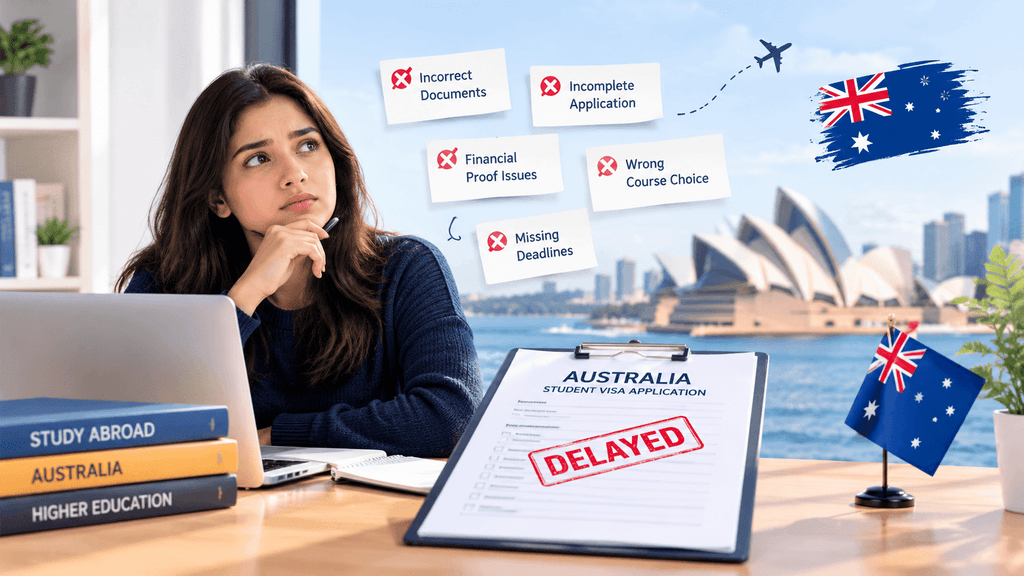
- Writing a GTE statement that sounds copied or too generic
- Sharing financial documents where the money source isn’t clear or convincing
- Buying OSHC for a shorter time than your actual course length
- Having an English score that meets the visa’s minimum but not what your course actually asks for
- Applying too close to your course start date, leaving no time buffer if something takes longer than expected
Quick note: If you’re going for research work instead of a regular degree course: you might actually need a subclass 408 (Temporary Activity) visa, not a student visa. It has its own separate English language requirement too. It’s worth checking which one fits your situation before you start preparing documents — so you don’t end up preparing for the wrong visa.
Conclusion
Getting an Australia student visa isn’t really about collecting a pile of documents. It’s about making sure everything you submit tells the same, honest story. Pick the right course and university for you, keep your finances clear and easy to explain, buy OSHC that covers your full stay, meet the English score your course actually needs, and write a Genuine Student (GS) statement that’s about you, not a template.
Go through the checklist more than once, apply with enough time to spare, and don’t rush the parts that matter most, especially your GS statement. Small gaps like mismatched dates, unclear fund sources, or study plans can slow down an otherwise strong application, so it’s worth reviewing every detail before you submit. Do this, and the process stops feeling confusing and starts feeling like something you’re actually in control of.
If you’d like an expert to review your file before you apply, the team at Esse India is here to help. You can contact Esse India for personalized guidance on your Australia student visa application.
Frequently Asked Questions
What’s the general process to apply for an Australia student visa?
You start with a confirmed offer from a registered institution, then arrange your finances, health cover, and English test score, followed by a genuine intent statement. Once these are ready, you submit your application online and track it through your immigration account until a decision is made.
Can international students eventually get PR in Australia after finishing their course?
Many students explore permanent residency pathways after completing their studies, though a student visa itself doesn’t automatically lead to PR. Eligibility depends on factors like your qualification, work experience, and the specific skilled migration route you choose to apply under later on.
Are Indian students still eligible to apply for Australian study visas?
Yes, Indian students remain one of the largest groups applying for Australian study visas. Eligibility isn’t based on nationality restrictions but on meeting the standard requirements — enrolment, finances, English proficiency, and a genuine intent to study, just like applicants from any other country.
How selective is the Australia student visa approval process?
It isn’t really about ticking boxes but about consistency. Genuine applicants with clear finances, a believable GTE statement, and complete documentation generally have a smooth experience. Most delays or refusals happen when parts of the application don’t align with each other, not because of strict selectivity.
Can Esse India guide me through my Australia student visa application?
Yes, Esse India supports students at every stage — shortlisting the right course and university, organising financial and academic documents, strong GTE statement, and guiding the final visa submission, so the process feels less overwhelming and more structured from start to finish.
Is Esse India considered a trustworthy option for Australia study visa help?
Esse India focuses on building genuine, document-backed applications rather than promising shortcuts. Students are guided based on their actual profile and circumstances, which is why many rely on it for honest advice on eligibility, documentation, and realistic expectations throughout the Australia student visa process.
What’s the maximum duration allowed to stay in Australia on a student visa?
Your permitted stay is tied to the length of your enrolled course, plus some additional time built in depending on your course level. It’s not a fixed period for everyone — it depends entirely on your specific program’s duration as stated on your Confirmation of Enrolment.
What sets a subclass 500 visa apart from a subclass 408 visa?
A subclass 500 visa is meant for structured study at a registered institution, while a subclass 408 covers short-term or research-based activities instead of a full degree. They also carry different English language requirements, so it’s important to confirm which one actually matches your situation.
What are the core requirements to qualify for an Australia student visa?
You’ll need a valid enrolment confirmation, proof you can financially support yourself, health cover for your stay, an accepted English test score, and a genuine intent statement. Together, these show the visa officer that your plan to study is realistic, consistent, and well thought out.
Are dependents like a spouse or children allowed under an Australia student visa?
Yes, your spouse or children can usually come with you on an Australia student visa. You just need to show you have enough extra money to support them while you’re there. It’s best to plan this early, since it changes how much money you need to show overall.